FMU ME: Van der Pol
This example demonstrates Model Exchange FMU integration with a nonlinear oscillator. The Van der Pol equation exhibits self-sustained oscillations:
where \(\mu > 0\) controls nonlinearity. As a first-order system:
You can also find the FMU integration tests in the GitHub repository.
This example demonstrates the ModelExchangeFMU block with purely continuous-time dynamics (no events), showcasing PathSim’s adaptive integration for nonlinear systems.
Import and Setup
[1]:
import numpy as np
import matplotlib.pyplot as plt

# Apply PathSim docs matplotlib style for consistent, theme-friendly figures
plt.style.use('../pathsim_docs.mplstyle')

from pathlib import Path
from pathsim import Simulation, Connection
from pathsim.blocks import ModelExchangeFMU, Scope
from pathsim.solvers import RKDP54, ESDIRK43
FMU Path
[2]:
notebook_dir = Path().resolve()
fmu_path = notebook_dir / "data" / "VanDerPol_ME.fmu"

# Verify FMU exists
if not fmu_path.exists():
    raise FileNotFoundError(f"FMU file not found at {fmu_path}")
System Definition
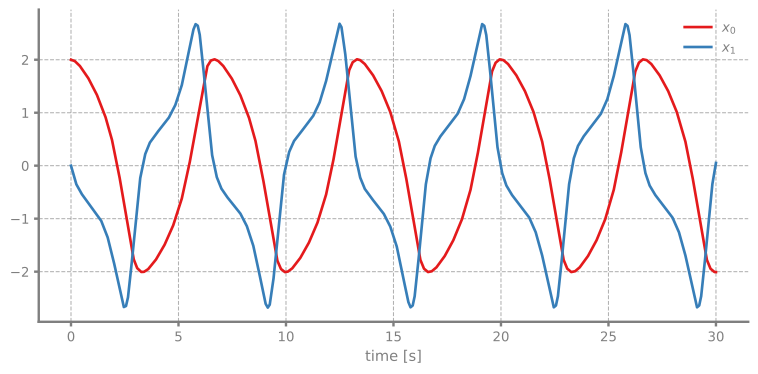
We simulate with \(\mu = 1.0\) for clear nonlinear oscillations:
The ModelExchangeFMU exposes states $(x_0, x_1)$ and provides derivatives to PathSim’s solvers.
[3]:
# Create Model Exchange FMU
fmu = ModelExchangeFMU(
    fmu_path=str(fmu_path),
    instance_name="vanderpol",
    start_values={
        "mu": 1.0,     # nonlinearity parameter
        "x0": 2.0,     # initial position
        "x1": 0.0,     # initial velocity
    },
    tolerance=1e-8,
    verbose=False
)

# Scope to record states
sco = Scope(labels=[r"$x_0$", r"$x_1$"])

blocks = [fmu, sco]

# Connections
connections = [
    Connection(fmu[0], sco[0]),
    Connection(fmu[1], sco[1]),
]
/tmp/ipykernel_5314/203168073.py:2: DeprecationWarning: 'ModelExchangeFMU' is deprecated and will be removed in version 1.0.0. Use 'pathsim_fmi.ModelExchangeFMU' instead. This block has moved to the pathsim-fmi package: pip install pathsim-fmi
  fmu = ModelExchangeFMU(
Display FMU metadata:
[4]:
# Display FMU metadata (accessed via fmu_wrapper)
md = fmu.fmu_wrapper.model_description
print(f"Model Name: {md.modelName}")
print(f"FMI Version: {fmu.fmu_wrapper.fmi_version}")
print(f"Description: {md.description}")
print(f"Generation Tool: {md.generationTool}")
print(f"\nContinuous states: {fmu.fmu_wrapper.n_states}")
print(f"Event indicators: {fmu.fmu_wrapper.n_event_indicators}")
print(f"Outputs: {len(fmu.fmu_wrapper.output_refs)}")
Model Name: Van der Pol oscillator
FMI Version: 2.0
Description: This model implements the van der Pol oscillator
Generation Tool: Reference FMUs (v0.0.39)

Continuous states: 2
Event indicators: 0
Outputs: 2
Simulation Setup
We use a high-order adaptive solver (RKDP54) for accurate nonlinear integration.
[5]:
# Initialize simulation
sim = Simulation(
    blocks,
    connections,
    dt=0.1,
    dt_max=0.1,
    Solver=RKDP54,
    tolerance_lte_rel=1e-6,
    tolerance_lte_abs=1e-9,
    log=True
)

# Run simulation
sim.run(30.0)
10:52:26 - INFO - LOGGING (log: True)
10:52:26 - INFO - BLOCKS (total: 2, dynamic: 1, static: 1, eventful: 0)
10:52:26 - INFO - GRAPH (nodes: 2, edges: 2, alg. depth: 1, loop depth: 0, runtime: 0.161ms)
10:52:26 - INFO - STARTING -> TRANSIENT (Duration: 30.00s)
10:52:26 - INFO - --------------------   1% | 0.0s<0.2s | 1784.6 it/s
10:52:26 - INFO - ####----------------  20% | 0.0s<0.1s | 2124.8 it/s
10:52:27 - INFO - ########------------  40% | 0.1s<0.1s | 2169.4 it/s
10:52:27 - INFO - ############--------  60% | 0.1s<0.1s | 2171.4 it/s
10:52:27 - INFO - ################----  80% | 0.2s<0.0s | 2172.6 it/s
10:52:27 - INFO - #################### 100% | 0.2s<--:-- | 2087.8 it/s
10:52:27 - INFO - FINISHED -> TRANSIENT (total steps: 415, successful: 351, runtime: 207.78 ms)
[5]:
{'total_steps': 415, 'successful_steps': 351, 'runtime_ms': 207.78222900025867}
Results
[6]:
sco.plot()
plt.show()
Relaxation Oscillations
For very large \(\mu\), the system exhibits relaxation oscillations with extreme stiffness. We use \(\mu = 500\) to demonstrate PathSim’s capability with severe stiffness:
Stiff systems require implicit solvers with large stability regions. We use ESDIRK43, a 4th-order implicit solver designed for stiff problems.
[7]:
fmu_stiff = ModelExchangeFMU(
    fmu_path=str(fmu_path),
    instance_name="vdp_stiff",
    start_values={"mu": 500.0, "x0": 2.0, "x1": 0.0},
    tolerance=1e-8,
    verbose=False
)

sco_stiff = Scope(labels=[r"$x_0$", r"$x_1$"])

sim_stiff = Simulation(
    [fmu_stiff, sco_stiff],
    [Connection(fmu_stiff[0], sco_stiff[0]), Connection(fmu_stiff[1], sco_stiff[1])],
    dt=0.1,
    Solver=ESDIRK43,          # implicit solver for stiff systems
    tolerance_lte_rel=1e-4,
    tolerance_lte_abs=1e-6,
    tolerance_fpi=1e-8,
    log=True
)

sim_stiff.run(1500.0)
10:52:27 - INFO - LOGGING (log: True)
10:52:27 - INFO - BLOCKS (total: 2, dynamic: 1, static: 1, eventful: 0)
10:52:27 - INFO - GRAPH (nodes: 2, edges: 2, alg. depth: 1, loop depth: 0, runtime: 0.130ms)
10:52:27 - INFO - STARTING -> TRANSIENT (Duration: 1500.00s)
10:52:27 - INFO - FINISHED -> TRANSIENT (total steps: 0, successful: 0, runtime: 4.89 ms)
---------------------------------------------------------------------------
ValueError                                Traceback (most recent call last)
Cell In[7], line 22
     18     tolerance_fpi=1e-8,
     19     log=True
     20 )
     21
---> 22 sim_stiff.run(1500.0)

File ~/checkouts/readthedocs.org/user_builds/pathsim/envs/v0.23.0/lib/python3.13/site-packages/pathsim/simulation.py:2032, in Simulation.run(self, duration, reset, adaptive)
   2030 #enter tracker context and consume the run loop
   2031 with tracker:
-> 2032     for _ in self._run_loop(duration, reset, adaptive, tracker=tracker):
   2033         pass
   2035 return tracker.stats

File ~/checkouts/readthedocs.org/user_builds/pathsim/envs/v0.23.0/lib/python3.13/site-packages/pathsim/simulation.py:1949, in Simulation._run_loop(self, duration, reset, adaptive, tracker)
   1945 while self.time < end_time and self._active:
   1946
   1947     #advance the simulation by one (effective) timestep '_dt'
   1948     try:
-> 1949         success, error_norm, scale, *_ = self.timestep(
   1950             dt=_dt,
   1951             adaptive=_adaptive
   1952             )
   1953     except StopSimulation as e:
   1954         self.logger.info(f"STOP (StopSimulation: '{e}')")

File ~/checkouts/readthedocs.org/user_builds/pathsim/envs/v0.23.0/lib/python3.13/site-packages/pathsim/simulation.py:1759, in Simulation.timestep(self, dt, adaptive)
   1755 for time_stage in self.engine.stages(self.time, dt):
   1757     if is_implicit:
   1758         #implicit: solve update equation (contains _update internally)
-> 1759         success, evals, solver_its = self._solve(time_stage, dt)
   1760         total_evals += evals
   1761         total_solver_its += solver_its

File ~/checkouts/readthedocs.org/user_builds/pathsim/envs/v0.23.0/lib/python3.13/site-packages/pathsim/simulation.py:1124, in Simulation._solve(self, t, dt)
   1122     if not block:
   1123         continue
-> 1124     self._solve_tracker.record(block, block.solve(t, dt))
   1126 #check for convergence
   1127 if self._solve_tracker.converged(self.tolerance_fpi):

File ~/checkouts/readthedocs.org/user_builds/pathsim/envs/v0.23.0/lib/python3.13/site-packages/pathsim/blocks/dynsys.py:131, in DynamicalSystem.solve(self, t, dt)
    129 x, u = self.engine.state, self.inputs.to_array()
    130 f, J = self.op_dyn(x, u, t), self.op_dyn.jac_x(x, u, t)
--> 131 return self.engine.solve(f, J, dt)

File ~/checkouts/readthedocs.org/user_builds/pathsim/envs/v0.23.0/lib/python3.13/site-packages/pathsim/solvers/_rungekutta.py:312, in DiagonallyImplicitRungeKutta.solve(self, f, J, dt)
    309     b = self.BT[self.stage][self.stage]
    311     #optimizer step with block local jacobian
--> 312     self.x, err = self.opt.step(self.x, x_0 + dt * slope, dt * b * J)
    314 else:
    315     #optimizer step (pure)
    316     self.x, err = self.opt.step(self.x, x_0 + dt * slope, None)

File ~/checkouts/readthedocs.org/user_builds/pathsim/envs/v0.23.0/lib/python3.13/site-packages/pathsim/optim/anderson.py:394, in NewtonAnderson.step(self, x, g, jac)
    391     return super().step(x, g)
    392 else:
    393     #newton step with residual
--> 394     _x, res_norm = self._newton(x, g, jac)
    396     #anderson step with no residual
    397     y, _ = super().step(_x, g)

File ~/checkouts/readthedocs.org/user_builds/pathsim/envs/v0.23.0/lib/python3.13/site-packages/pathsim/optim/anderson.py:361, in NewtonAnderson._newton(self, x, g, jac)
    358     _lu = lu_factor(_A)
    359     self._A, self._lu = _A.copy(), _lu
--> 361 return _x - lu_solve(_lu, _res), np.linalg.norm(_res)

File ~/checkouts/readthedocs.org/user_builds/pathsim/envs/v0.23.0/lib/python3.13/site-packages/scipy/linalg/_decomp_lu.py:188, in lu_solve(lu_and_piv, b, trans, overwrite_b, check_finite)
    135 """Solve an equation system, a x = b, given the LU factorization of a
    136
    137 The documentation is written assuming array arguments are of specified
   (...)    185
    186 """
    187 (lu, piv) = lu_and_piv
--> 188 return _lu_solve(lu, piv, b, trans=trans, overwrite_b=overwrite_b,
    189                  check_finite=check_finite)

File ~/checkouts/readthedocs.org/user_builds/pathsim/envs/v0.23.0/lib/python3.13/site-packages/scipy/_lib/_util.py:1181, in _apply_over_batch.<locals>.decorator.<locals>.wrapper(*args, **kwargs)
   1179 # Early exit if call is not batched
   1180 if not any(batch_shapes):
-> 1181     return f(*arrays, *other_args, **kwargs)
   1183 # Determine broadcasted batch shape
   1184 batch_shape = np.broadcast_shapes(*batch_shapes)  # Gives OK error message

File ~/checkouts/readthedocs.org/user_builds/pathsim/envs/v0.23.0/lib/python3.13/site-packages/scipy/linalg/_decomp_lu.py:195, in _lu_solve(lu, piv, b, trans, overwrite_b, check_finite)
    192 @_apply_over_batch(('lu', 2), ('piv', 1), ('b', '1|2'))
    193 def _lu_solve(lu, piv, b, trans, overwrite_b, check_finite):
    194     if check_finite:
--> 195         b1 = asarray_chkfinite(b)
    196     else:
    197         b1 = asarray(b)

File ~/checkouts/readthedocs.org/user_builds/pathsim/envs/v0.23.0/lib/python3.13/site-packages/numpy/lib/function_base.py:630, in asarray_chkfinite(a, dtype, order)
    628 a = asarray(a, dtype=dtype, order=order)
    629 if a.dtype.char in typecodes['AllFloat'] and not np.isfinite(a).all():
--> 630     raise ValueError(
    631         "array must not contain infs or NaNs")
    632 return a

ValueError: array must not contain infs or NaNs
[8]:
time_stiff, (x0_stiff, x1_stiff) = sco_stiff.read()

fig, axes = plt.subplots(2, 1, figsize=(10, 6), sharex=True, dpi=130)

axes[0].plot(time_stiff, x0_stiff, lw=2)
axes[0].set_ylabel(r'$x_0$')
axes[0].set_title(r'Relaxation Oscillations ($\mu = 500$)')
axes[0].grid(True, alpha=0.3)

axes[1].plot(time_stiff, x1_stiff, lw=2, color='orange')
axes[1].set_xlabel('Time [s]')
axes[1].set_ylabel(r'$x_1$')
axes[1].grid(True, alpha=0.3)

plt.tight_layout()
plt.show()
Key Features
Seamless integration of nonlinear dynamics
Adaptive timestepping for varying dynamics
Parameter sweep capabilities
Handles moderately stiff systems